The Virtual Power Plant (VPP) is the single biggest opportunity in energy in decades.
Imagine energy becoming bi-directional, decentralized, and democratized in a way that we have never seen before. And it is all happening right now.
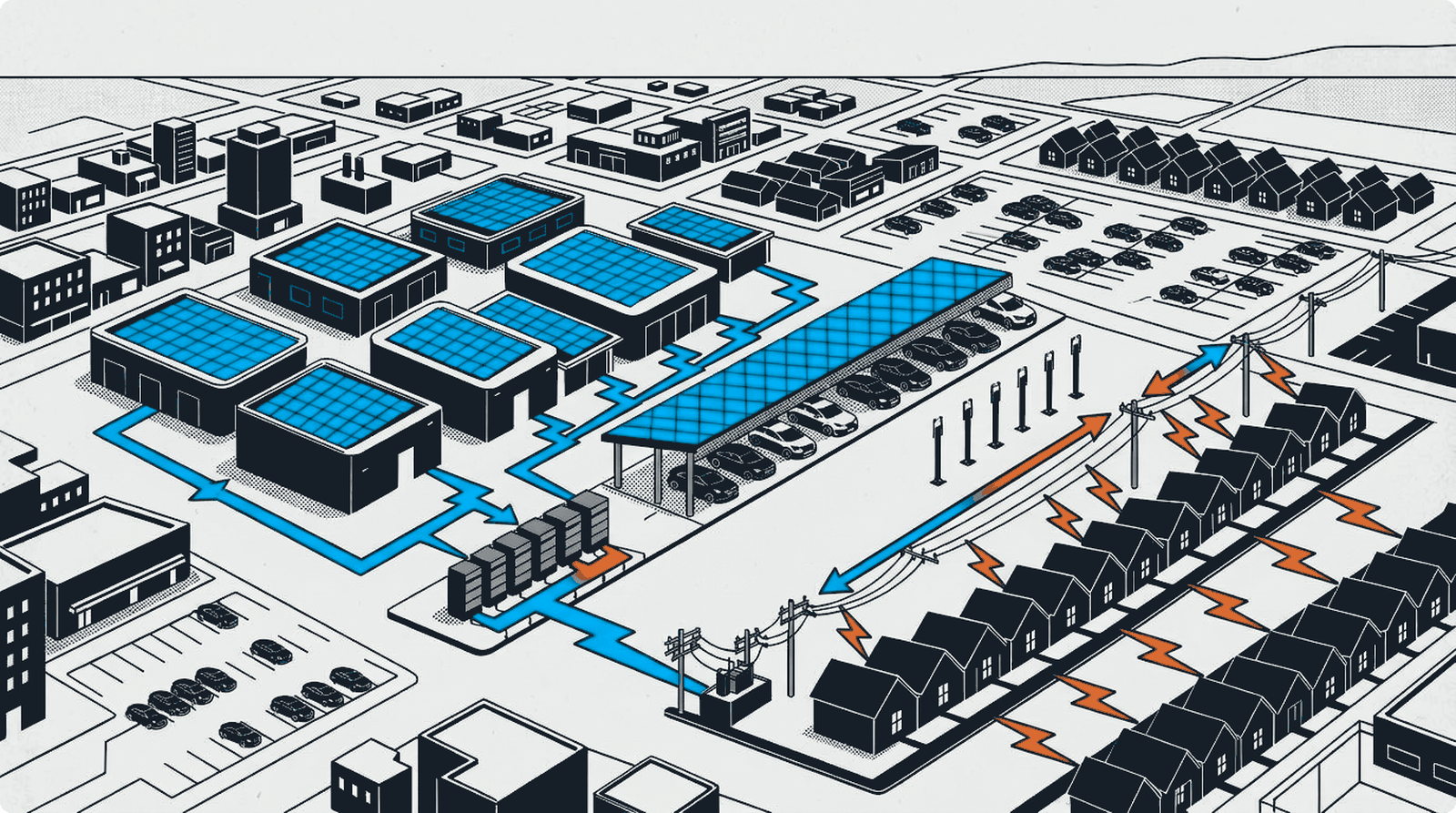
Virtual Power Plants (VPPs) are what truly unlock the value of battery storage.
While the term “virtual power plant” may call to mind what you built to keep the lights in your Sim City on, they are really one of the most valuable assets on the grid today. A virtual power plant is a few hundred or thousand distributed energy resources (DERs), batteries mostly, plus flexible loads like EV chargers and heat pumps, that are aggregated and coordinated by an operator and dispatched as a single unit.
The VPP operator bids that combined capacity into the wholesale electricity market the same way the owner of a peaker plant does, and the grid gets megawatts from an assortment of battery packs, parking lots, and HVAC systems instead of one big natural gas power plant.
Each individual component in the VPP gets a share of what the whole earns, in exchange for letting its battery be called on during the handful of hours a year when the grid is genuinely short. Often this translates to a few dozen hours of participation a year, typically on summer evenings when demand spikes to its annual highs, but year-round VPP programs that unlock their full potential are in the works right now.
But why does this actually matter? You may be reading this thinking that a few dozen hours don't make a huge difference. But there are two things that are at play. One being the fact that it takes quite a bit of time and energy to fire up a peaker plant. At the same time, those dozens of hours are becoming days as more people use more energy, more often, and for longer than ever before.
What has been going on in the background to make a more resilient grid.
A super significant change to how VPPs can play into the grid happened just this year, but it was pretty technical and has so far been largely unnoticed. CAISO revised how it accounts for aggregated distributed resources, treating an aggregator as a discrete resource inside a sub-load aggregation point, one of the twenty-odd geographic zones the California transmission grid is divided into.
What it means in plain terms: a group of behind-the-meter batteries can now push power out into their own local grid zone, up to the point where net load in that zone reaches zero, and get paid wholesale market value for it. VPP resources were effectively locked out of the resource adequacy market over deliverability concerns, but the technology is now mature enough that they can be treated just like any other power plant on the grid.
Capacity and reliability is what utilities are looking for.
The grid only values capacity it can count on getting where it is needed. Historically a behind-the-meter battery could not prove that, so it was excluded from resource adequacy no matter how real its megawatts were. Reclassifying aggregations inside a local zone is what makes the capacity countable, because it is being counted locally rather than across the whole system.
Brian Turner, who directs regulatory affairs at Advanced Energy United, called it “a small accounting change that could significantly change the battery market in California,” and estimates it could bring upwards of 2 GW of behind-the-meter batteries and aggregated resources into the wholesale market.
What Sacramento is doing about it.
Two bills introduced by Senator Josh Becker that solve different halves of the same problem have successfully made their way through the California Legislature and, at time of writing, are waiting for Governor Newsom's signature to be passed into law.
SB 905 is about knowing where there is room. It would establish a grid utilization metric measuring the load factor on distribution circuits, and require the large utilities to publish data showing how much more their existing circuits could carry. In essence, this would create a resource siting map, showing where distributed resources can be added without anybody physically rebuilding the grid. This is huge because adding more traditional energy to the grid is an expensive and time-consuming process that just can't keep up with today's growing energy demand.
SB 913, the Clean Local Power Act, is about getting paid. It would require the CPUC to establish a valuation framework for customer-sited batteries exporting to the grid during periods of stress. This matters because California currently has no compensation mechanism for that at all. If passed, the state has a permanent VPP program that does not depend on being funded again in each budget cycle, something past state VPP programs have traditionally struggled with.
“Expanding the size of grid equipment to serve a small number of hours of higher usage wastes ratepayer dollars.”
When it actually happens for the grid.
The CAISO accounting changeAggregations become discrete resources inside their local zone, which is what makes VPP export worth wholesale value instead of an electric bill credit.
SB 905 and SB 913 reach the governorIf signed, the CPUC gets a mandate to build the valuation framework, and the utilities get a publishing requirement on circuit headroom.
The CPUC demand response proceedingThese are the rules that determine what a building is actually paid for their energy resources.
The optimistic caseFull resolution of the CPUC proceeding could run to February 2028, and the two bills direct the state to have solutions mapped out by 2028.
But VPPs are already here, and are continuing to improve
After all of the discussion of what is coming, it is hard to forget what is already here. So, it is worth separating because oftentimes both get blurred together. California's Demand Side Grid Support program has more than 1 GW of distributed batteries enrolled today and is one of the country's leading VPP programs. So buildings are already being paid to discharge energy out of their batteries. What the CAISO change and the two bills do is take that from a state program with a budget line to a market with a price. And there are also local and regional VPP programs coming online soon from public benefit electricity providers like MCE and 3CE.
What does it mean for you?
A battery on a commercial site earns in more than one way at once, and the ones arriving are additive to the ones already there rather than replacing them. This is the part that surprises people, and it is the reason the paybacks have been looking better and better. Also, let's not forget that having a battery at your commercial site also can offset the energy usage of the building itself. Once that is stabilized, to know that you can stack revenue in all of these different programs truly makes a battery a revenue generator.
There are three requirements to have your battery VPP ready.
The inverter has to be capable of exporting energy. The system also needs to have telemetry and external control. Most do, but this allows an aggregator to be able to see the state of charge and issue a dispatch command at any time when it is needed. The equipment also has to be approved by each VPP provider. Popular battery manufacturers usually fall under this category so most qualify for this one.
A quick look at history and where the future is going
When our energy grid first was developed, there wasn't a lot of access for those that lacked the massive resources required. It was a money game and it only widened the wealth gap. Today, we don't think about energy as something that we can control, that we can participate in, or that anybody can have access to. But that day has come. Batteries can be purchased outright for the most benefit financially, they can be financed at a rate where the savings and revenue often pay back in 25% of the time of the loan, or you can simply save money on your energy by allowing an organization to use some of your commercial space to place a battery. So, it isn't a matter of if it is worth it, it's which path is going to be the one chosen for each organization.
Sources: CAISO CPUC Advanced Energy United CALSSA Utility Dive Solar Power World