What comes after community solar? Community energy.
Front-of-the-meter solar on commercial roofs and parking lots already makes clean power close to where it is used. Pairing it with batteries lets that power reach the grid in the evening, when it is needed most. Energy storage is the key to it all.
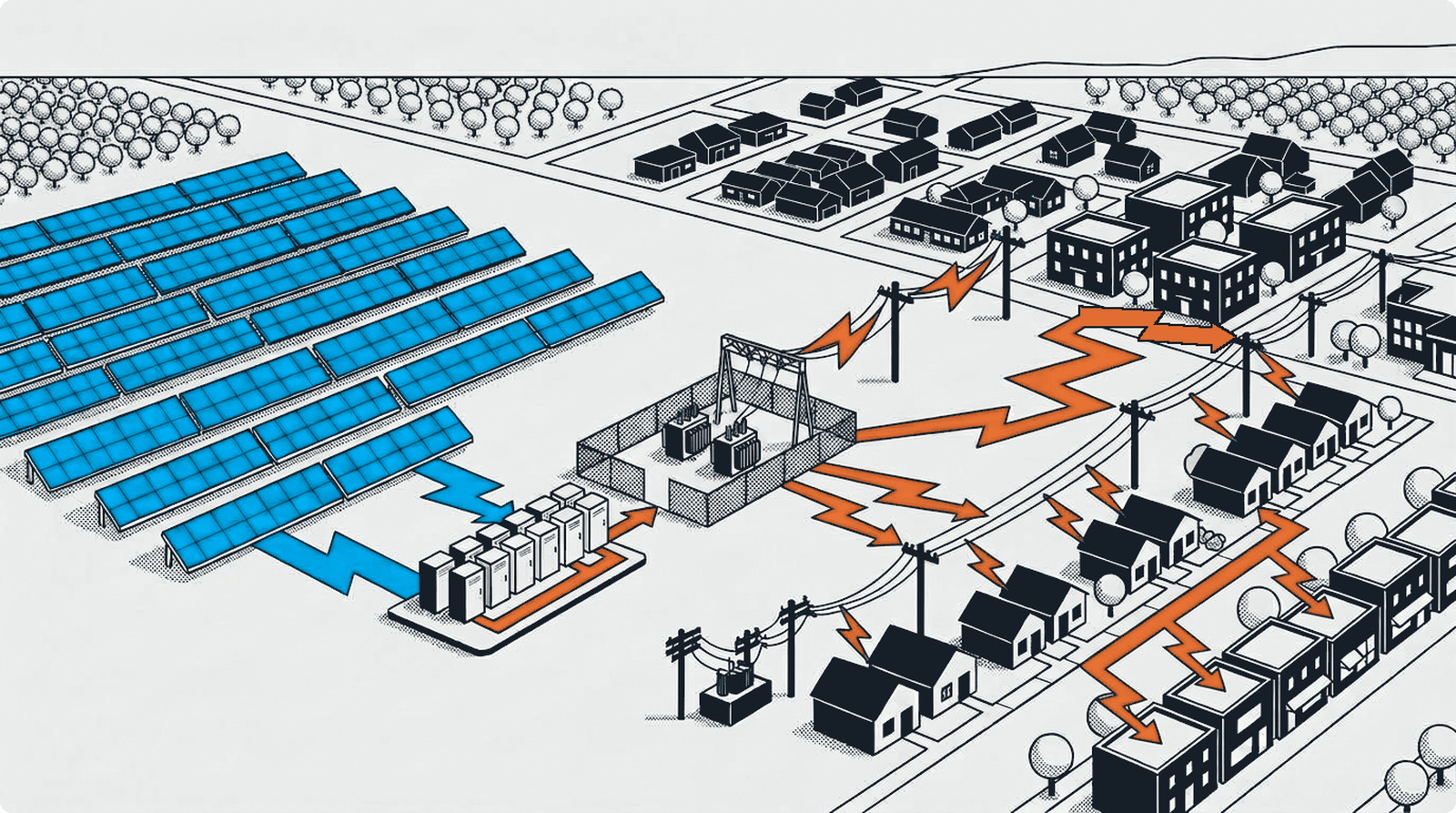
For about a decade, community solar has meant a fairly simple idea: build one shared solar project close to where people and businesses use power, send that power out onto the local grid, and credit the output to the customers who sign up for it. It has done a lot of good, and across the country it has grown past 10 GW. But a solar project only produces while the sun is up, and in California the grid needs the most power after 5 p.m., when solar is fading and demand is at its peak.
Pair that same project with a battery and it becomes something more useful, because it can store the midday output and deliver it in the evening, on the local wires, to the businesses and homes around it. That combination is what we mean by community energy. It builds on what community solar has already put in place, the projects, the interconnections, the commercial roofs and lots, and turns them into local capacity the grid can count on.
Homes are part of that picture, but most of the roofs, the land and the demand are commercial, so that is where we will spend most of our time. Let’s break it down.
What is community solar?
Community solar is a solar project that many customers share. Instead of every building putting panels on its own roof, one larger project gets built nearby and its output is credited to the customers signed up to it, who can be households but just as easily businesses, schools, cities and nonprofits.
US community solar passed 10 GW at the end of 2025, according to Wood Mackenzie, which notes that these projects are frequently anchored by non-residential customers. In most of the markets that have grown, businesses are what get projects financed, since a large subscriber taking a big share of the output makes the revenue predictable for the life of the project.
What does “front of the meter” mean?
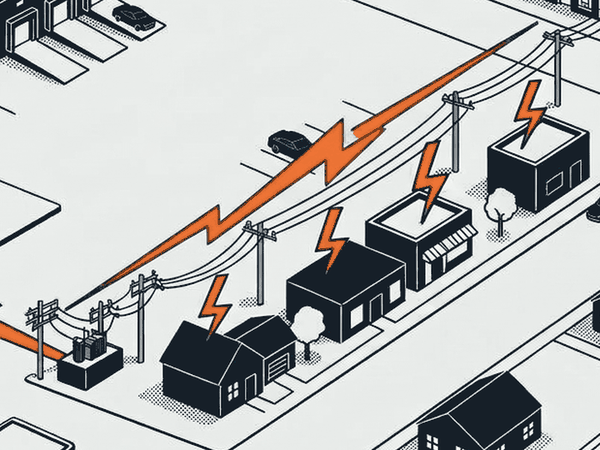
A front-of-the-meter project sells its power onto the grid instead of into the building it sits on. Behind-the-meter solar lowers one customer’s bill, while front-of-the-meter solar serves the whole area around it.
The meter is the line. Panels on a warehouse roof that run the warehouse are behind the meter, and the savings stay with the warehouse. Put the same panels and the same batteries on the same roof but send the power out past the meter, and the roof becomes a small local power plant with exactly the same equipment doing a completely different job.
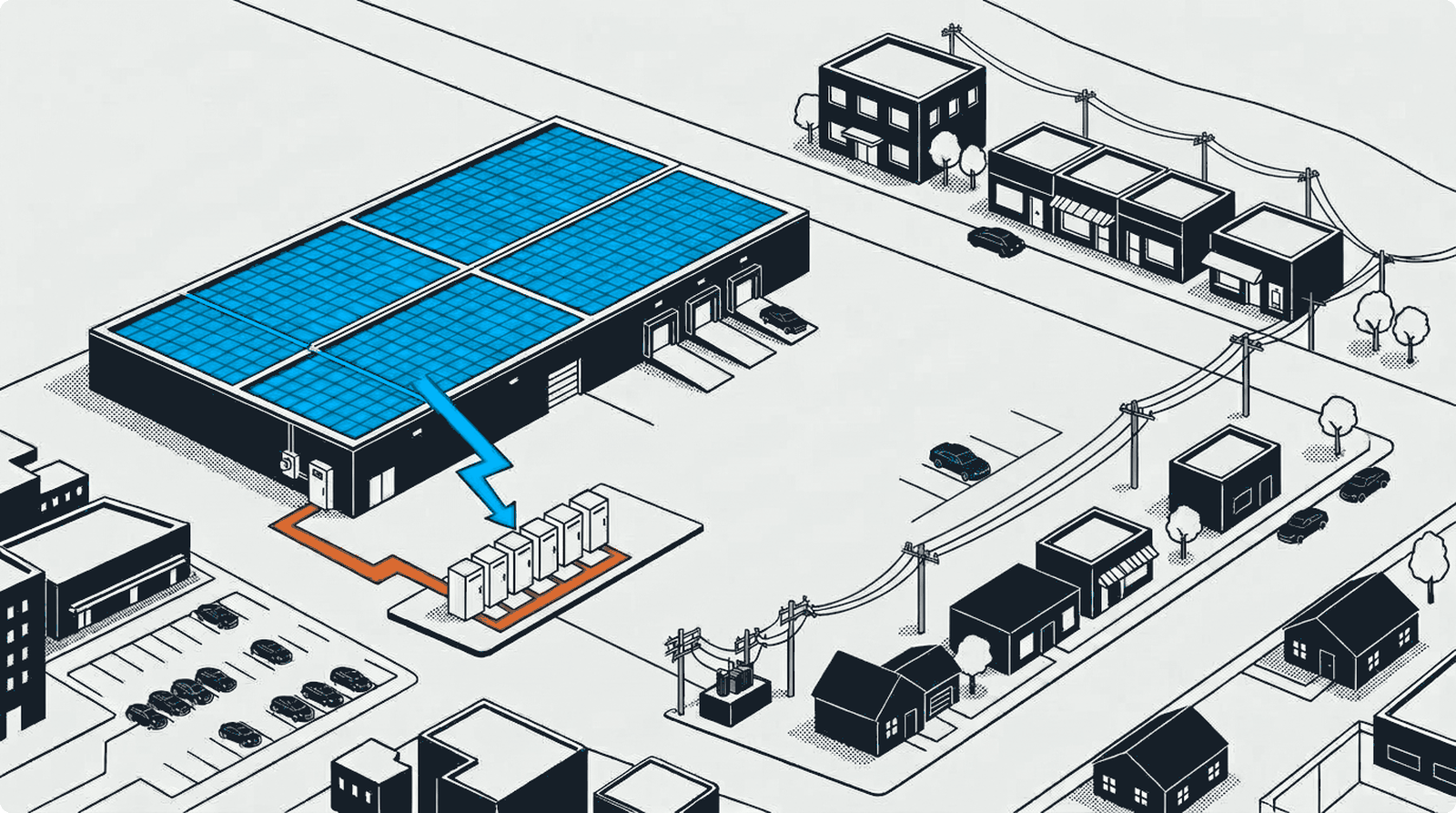
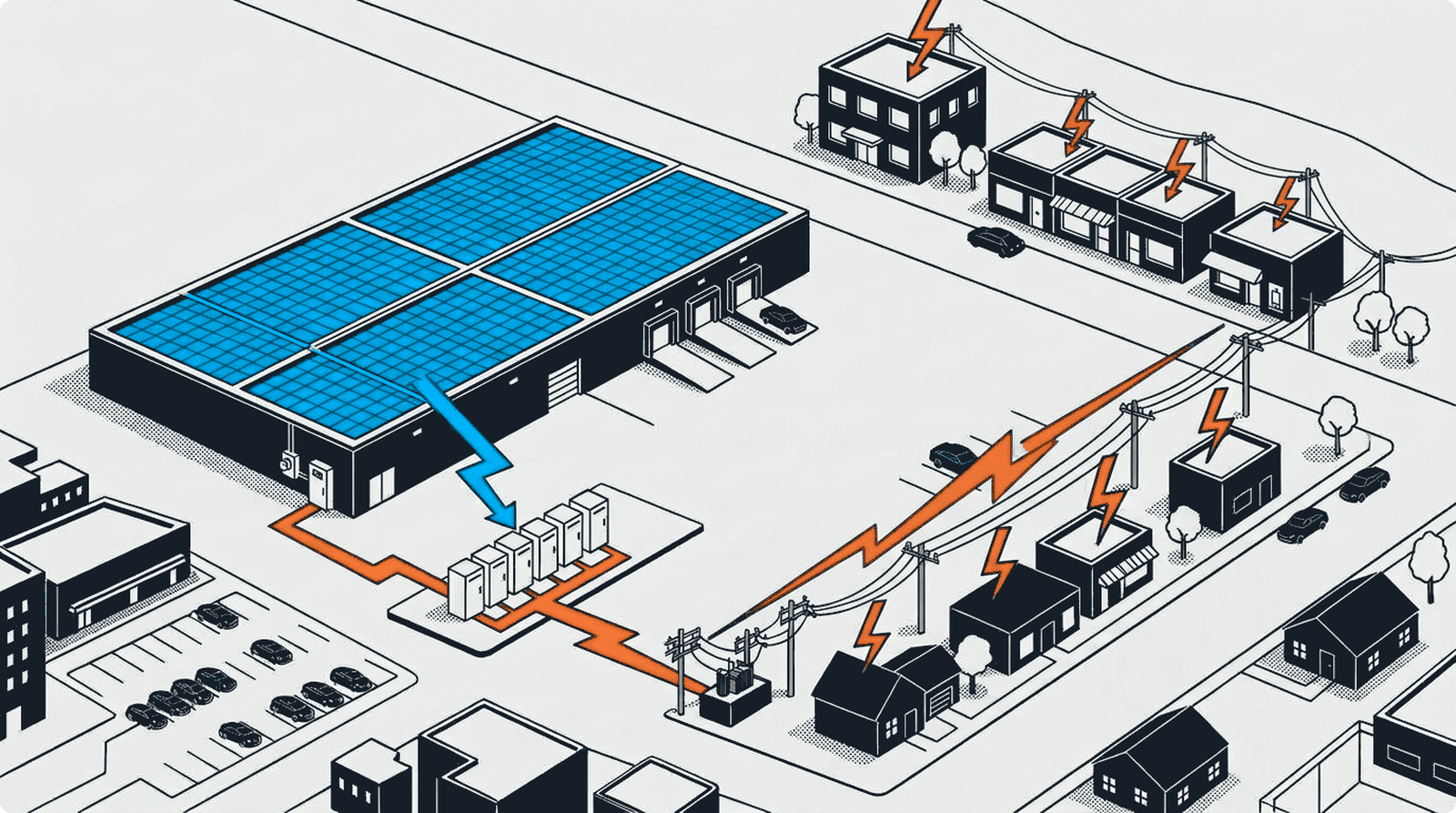
These projects are not the giant desert solar farms you see from the freeway, which connect to the high-voltage transmission system and ship power hundreds of miles. Community projects connect to the local distribution network, the same poles and wires that already run down the street, under the state’s interconnection rules (Rule 21) or the utility’s wholesale distribution tariff. In California they range from about 0.5 MW to 20 MW depending on the program, and the CPUC’s newest program caps them at 3 MW.
If you run a business, one detail is worth knowing up front. A community solar subscription is credited per kilowatt-hour, so it does not touch your demand charges, which NREL puts at 30% to 70% of a typical commercial bill, and bringing those down takes storage on your own side of the meter. We get into that in our energy economics article.
Why does storage turn community solar into community energy?
Solar makes the most power at noon, and California needs the most power after 5 p.m.
California has built so much solar that on a sunny spring afternoon there is more of it than the grid can use, and when that happens CAISO, the state’s grid operator, has to switch some of it off. That is called curtailment, and it grows every year. In 2025 roughly 3.77 terawatt-hours of wind and solar was curtailed, a record, and more than 90% of it was solar.
At the other end of the day, CAISO forecasts the state’s 2026 peak for September at around 6 p.m., and the tightest hours on the grid run from 5 to 11 p.m., after the sun has gone. A battery charges on the noon surplus that would otherwise be curtailed and gives it back during those evening hours, when every kilowatt-hour is worth the most.
California already runs storage at scale. The CEC counted more than 21,000 MW of battery capacity serving the state in August 2026, and batteries now carry a large share of the evening ramp. Most of it sits in big utility-scale plants, though, and very little of it is paired with local, front-of-the-meter solar. The CPUC began allowing its Green Tariff projects to pair solar with storage in 2024, and in Massachusetts almost two thirds of the community solar built under its SMART program is already paired with storage, according to NREL.
Community energy is that pairing done locally. The solar sits on a commercial roof or a lot, the battery sits next to it, and together they deliver power to the surrounding area when the grid is under the most strain. We’ve written more about how batteries earn on the grid in our VPP article.
Where do businesses fit in?
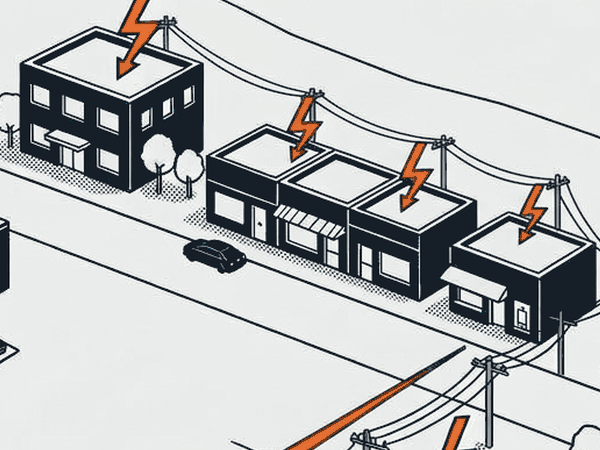
A business can take part in three ways: as the host, as the subscriber, and as the ratepayer who pays for the grid either way.
The host
A roof, a parking lot or a piece of land earns lease income for hosting a project whose power goes to the grid.
The subscriber
A business, school or city signs up for a share of a local project’s output and sees it on the bill.
The ratepayer
Every business pays for the wires. Local generation is one of the few things that can slow how fast that cost grows.
Hosting is the biggest opportunity and the most commercial one. California has more than 66,000 large commercial roofs suited to community solar, according to a study by the Brattle Group for the developer Solar Landscape, which also found that urban rooftop solar paired with storage delivers more value to ratepayers than the same project built on open land far away. The property owner leases the roof or lot, the developer builds and runs the project, and the power goes out to the grid. Industry lease rates run around 25 to 85 cents per square foot per year, usually on 20-year terms.
Subscribing is where California gets complicated. The CPUC says about 60,000 commercial customers are signed up to community solar programs statewide, but the options open to a business today are thin. The Green Tariff is open to commercial customers, PG&E’s version of it, Solar Choice, has paused new enrollment, the program that tied a subscription to a specific local project closed in 2024, and community choice aggregator (CCA) programs such as MCE’s Local Sol, which offered small businesses local solar at a fixed rate through 2035, have filled up.
Every business is a ratepayer. California commercial power averaged 30.56¢ per kilowatt-hour in July 2026 against 14.53¢ nationally, more than twice the national rate, and across the three big utilities distribution and transmission together make up roughly 45% to 55% of the average rate, according to the CPUC. That share of the bill is the part local generation and storage can help with.
How does community solar work in California today?
Mostly through a few CPUC programs and the CCAs that run their own versions. Counting all of them, the CPUC reported 560 MW of community solar operating and another 165 MW under construction in April 2026, serving about 125,000 residential and 60,000 commercial customers. That base of built projects is what community energy can build on.
The program doing the most direct good is the Disadvantaged Communities Green Tariff, or DAC-GT. A utility or CCA signs a long-term contract for a new local solar project, often on a commercial roof, and income-qualified households in the state’s most burdened communities get 20% off their electric bill automatically.
What does front-of-the-meter energy do for the grid?
It makes power where people and businesses use it, on wires that already exist, so less has to be hauled hundreds of miles over transmission lines that are quickly becoming one of the most expensive parts of a California bill.
The CAISO charge for using the high-voltage grid went from $10.35 per megawatt-hour in 2017 to $13.95 in 2025. Between 2000 and 2022 CAISO approved about $733 million of new transmission a year, and since 2023 it has averaged $6.64 billion a year, nine times as much according to the CPUC’s Public Advocates Office, all of it recovered through rates.
Power made a block away loses less of itself on the way than power shipped across the state, since about 5% of US electricity is lost in transmission and distribution, per EIA. A well-sited project also plugs into grid capacity that is already paid for, and utilities publish hosting-capacity maps showing where the local grid can take new generation without upgrades. It can use warehouse roofs and parking lots instead of farmland or open desert, and with a battery it covers the evening hours, when the grid is tightest and new transmission and peaker plants are hardest to justify.
This is also where the policy fight is. The CPUC has so far declined to credit community solar for the transmission and distribution costs it may avoid, and supporters say local power clearly reduces the need for new wires while the CPUC says that hasn’t been shown project by project. How that question is settled decides what these projects get paid, and so whether they get built.
Why is California’s community energy market less mature than other states’?
California leads the country in solar, but it has never set up a community solar program that projects can finance at scale, so outside a handful of utility and CCA programs there is very little market here. Wood Mackenzie counts 24 states plus Washington, D.C. with community solar laws, and California is not among the 15 markets it expects to grow over the next few years.
The states with mature markets got a few structural things right early. They set a credit for the power that reflects what it is worth to the grid and that a lender can underwrite for 20 years, as New York did with its Value Stack (2017) and Illinois did with long-term contracts for the project’s renewable credits. They let businesses anchor projects, with rules that reserve the rest of each project for smaller subscribers. And Massachusetts tied its incentive to storage, first with an adder for pairing and now with a requirement on larger projects.
California has spent the same years going back and forth on the first of those, and it has not yet valued storage paired with community solar at all. In 2022 the legislature passed AB 2316, which told the CPUC to build a broader community solar program, and here is what has happened since:
DAC-GT and CSGTThe CPUC creates the two programs for disadvantaged communities.
AB 2316The legislature directs the CPUC to create a broader community solar program, with at least 51% of each project serving low-income customers.
The industry design is rejectedThe CPUC turns down the proposed Net Value Billing Tariff, closes the program that tied subscriptions to local projects, and lets the Green Tariff pair solar with storage.
State money pulled backThe state budget reverts $33 million set aside for community solar and storage-backed programs.
Solar for All terminatedThe EPA ends the program, including California’s $250 million award.
A new CPUC programBuilt on the state’s existing small-generator contract (ReMAT): projects up to 3 MW, 20-year contracts, no adder for storage, and the utility keeps the renewable credits. Open to businesses in principle, but the credit for anyone who isn’t low-income depends on outside funding that doesn’t exist yet. The industry calls it unworkable.
Federal tax credit deadlineSolar projects had to start construction by this date to keep the investment tax credit past 2027.
Solar for All back in courtTwo federal courts set the termination aside. California’s own lawsuit is still pending, and no money is flowing yet.
AB 1813 vetoedThe bill would have paid projects at their avoided cost and allowed up to 5 MW of solar plus 5 MW of storage each, capped at 4 GW statewide.
AB 1813 would have paired every project with as much storage as solar, which is the version of community energy that addresses the evening problem. The case against it came down to price: the CPUC, and now the Governor, have said the proposed credits would pay more than the power is worth and that the difference would land on everyone else’s bills, while supporters say these projects are worth more to the grid than the CPUC credits them for.
What would more community energy mean for California?
More of the state’s commercial roofs and lots working as local power plants, more evening capacity close to where it is used, and less pressure on the most expensive wires on everyone’s bill.
Most of the pieces are already here. There are tens of thousands of suitable commercial roofs, 560 MW of community solar already operating, and more than 21,000 MW of proven battery capacity on the grid. A record amount of midday solar is being thrown away while the evening peak strains the system, transmission spending is up ninefold, and businesses are paying more than twice the national commercial rate.
What California still needs is a program that values local solar and storage for what they do for the grid, in a way projects can finance. With that in place, the community solar already built becomes the starting point for community energy, and every warehouse roof in the state becomes a candidate.
Questions people ask about community energy
What is community energy?
Community energy is local, front-of-the-meter generation paired with storage and shared across the businesses and homes around it. It builds on community solar by adding batteries, so the power can be delivered in the evening when the grid needs it most.
Can businesses subscribe to community solar in California?
In some places, but the options are thin right now. The CPUC’s Green Tariff is open to commercial customers, PG&E’s version has paused new enrollment, and several CCA programs that served small businesses are full.
Can my business host a community solar project on its roof or parking lot?
Yes. A developer leases the space, builds and runs the project, and sells the power to the grid, while the owner earns lease income, typically on a 20-year term. Depending on the program, California projects range from about 0.5 MW to 20 MW, and the newest program caps them at 3 MW.
What does front of the meter mean?
A front-of-the-meter project sells its power onto the grid instead of into the building it sits on. Behind-the-meter solar lowers one building’s bill, and front-of-the-meter solar serves the area around it.
Why pair community solar with battery storage?
Solar produces most at midday and California needs the most power after 5 p.m. A battery stores the midday surplus, which the grid would otherwise curtail, and delivers it during the evening peak.
Why does California curtail solar?
On sunny days, especially in spring, the state produces more solar than the grid can use or export. CAISO curtailed a record 3.77 TWh of wind and solar in 2025, more than 90% of it solar.
Does a community solar subscription lower demand charges?
No. Community solar credits are per kilowatt-hour, while demand charges are set by a building’s highest 15-minute draw, and lowering them takes storage on the building’s own side of the meter.
Do businesses get the renewable energy credits from community solar in California?
Under the CPUC’s newest program, no. The utility keeps them, and subscribers have to be told so.
Is community solar available to households in California?
Yes, for income-qualified households in disadvantaged communities, through DAC-GT, which takes 20% off the bill automatically. California does not yet have an open market that anyone can join.
Sources: CPUC CPUC Public Advocates Office CAISO CEC EIA NREL Wood Mackenzie MCE PG&E Brattle Group